Since 2001: past, present and future of democratic municipalism through decentralized
cooperation and public participation.
The emergence of participatory democracy and the rise of municipalism as two sides of the same
coin.
The idea and practice of participatory democracy emerged in Latin America in a context of democratic recovery and strong mobilization of social actors such as unions, neighborhood associations and other social movements. It also appeared in countries of the global North, largely as a response to the crisis of representative democracy, as seen in the increase in political disaffection, distrust of political parties and institutions, and the decline in electoral turnout or voting for extremist parties.
Participatory democracy emerged from social movements and popular demands in bottom-up form and was theorized by various authors such as Carole Paterman, Leonardo Avritzer, Boaventura de Sousa Santos, Yves Cabannes, Yves Sintomer and others. This surge of experiences was quickly institutionalized through different mechanisms such as participatory budgets, neighborhood councils or participatory planning. This uptake by institutions has been an opportunity to articulate social demands but it has also been critically received as a way to appease and delimit social demands or to clientelize the social fabric.
We can therefore distinguish two spaces and two forms of emergence of participatory democracy: in the global south with a more radical and redistributive dimension, and in the north as a response to the growing distrust of institutional politics.
With respect to the emergence in Latin America, we can highlight the triangle formed by three cities: Montevideo in Uruguay, Porto Alegre in Brazil and Rosario in Argentina. In these three cities, from the 1980s onwards, various movements of resistance to the dictatorships, i.e., a strong civil society, were conjured up. When elections were resumed, there was an enormous aspiration at the local level for true democracy, which inspired participatory processes. The participatory budget with its elected delegates in Porto Alegre and the different Neighborhood Councils and participatory processes led by civil society in Montevideo and Rosario.
Politically, this movement of democratic radicalization merged into the municipalist movement, which is committed to cooperation and dialogue at regional and international level. Municipalism is a century-old movement that has always been linked to the defense of peace, human rights, cooperation and the open exchange of ideas and practices. Currently, the municipalist movement is made up of a multitude of networks, organizations, foundations and associations, but its global representation is framed within the World Organization of United Cities and Local Governments (UCLG), the organization that hosts the OIDP network.
In this way, participatory democracy practices were disseminated, replicated and innovated. Various cooperation programs between local governments emerged and bilateral relations between cities were strengthened. The World Social Forums were also a propitious space for the multiplication of these practices of participatory democracy and fed the various networks and spaces for city-city cooperation.
The URBAL programs of the European Commission for cooperation between cities in Europe and Latin America were an excellent example of this decentralized cooperation that allowed the expansion of participatory democracy experiences through the systematization of practices, their guides to good practices and evaluation and their spaces for exchange. It is through these programs that the International Observatory of Participatory Democracy - OIDP was born. With a type A program for the definition of frameworks and theoretical concepts, such as evaluation guides and then through a type B program for the practical implementation of local observatories.
From November 21 to 24, 2001, the founding conference of the OIDP took place in the city of Barcelona. It was thanks to the leadership of the Catalan capital, a city that is very active in international relations and that developed various participation and volunteering practices linked in part to the internal decentralization of the municipality, along with the role of Porto Alegre as a pioneer city in participatory budgeting and the social forums and other French municipalities such as Saint-Denis with an active international agenda that this network was launched.
The founding cities and local governments of the OIDP were: Barcelona City Council (Spain), Cuenca Municipality (Ecuador), Delgado Municipality, Department of San Salvador (El Salvador), Ville d'Issy-les-Moulineaux (France), City Council of Jerez de la Frontera (Spain), Municipal Government of La Paz (Bolivia), Ville de Lille (France), Municipal Prefecture of Porto Alegre (Brazil), Municipality of Quetzaltenango (Guatemala), Government of Risaralda (Colombia) and the Ville de Saint-Denis (France)
At its first conference, the OIDP adopted regulations to help organize the network while keeping it agile and free of unnecessary bureaucracy. From the beginning—and still today—it has been envisioned as a space of voluntary collaboration among cities across the world, working hand in hand with civil society and academia. Through the exchange of experiences, knowledge, and ideas, the network promotes vibrant local democracies with inclusive and effective channels of participation that bring people into the heart of civic life in their cities and territories.
In the early years of the OIDP, the dynamics of organizing an annual international conference, each time in a different continent, was initiated as a space for reflection and exchange of experiences. Also in the early years, periodic meetings of network partners were organized and various methodological guides were developed to systematize and conceptualize participatory democracy practices.
Under the umbrella and with funding from the URBAL program, the Local Observatories of Participatory Democracy (OLDP) project was launched. The project consisted of creating local observatories in the different partner cities with the participation of the local administration, civil society -organized or not- and academia.
The specific objectives of the project were constituted as instruments for the realization of the demands and also reflected the great potential of a collective, participatory and varied methodology in the various spheres of action of the OLDPs:
The first edition of this award took place in 2006 with the aim of recognizing good practices carried out by local governments, inspiring other cities and helping to systematize experiences. In this first edition, 39 nominations were received, and the award went to Cotacachi, Ecuador, for the "processes and mechanisms for the inclusion of indigenous women in local management".
Over the years, the Award has continued to be organized as one of the Observatory's main activities. Every year a call is made for local and regional governments to propose their best practices in democratic participation and innovation, and they are evaluated through an international jury. As of 2018, an open evaluation phase has been incorporated so that all OIDP partners and other interested persons can participate in the evaluation of practices.
It is within the framework of the OIDP conference that the trophy is awarded to the winning experience and the diplomas for the special mentions. Finally, the Technical Secretariat prepares a publication with the various nominations submitted and they are also published as good practices in the dedicated space on the website.
The winners of the Award have been:
Cotacachi (Ecuador) in 2006, Belo Horizonte (Brazil) en 2007, Recife (Brazil) in 2008, Mexico City (Mexico) in 2009, Rosario (Argentina) in 2010, Madrid (Spain) in 2012), Lisboa (Portugal) in 2013, Chengdu (China) in 2014, Quart de Poblet (Spain) in 2015, Canoas (Brazil) in 2016, La Paz (Bolivia) in 2017, Taoyuan (Taiwan) in 2019, Buenos Aires (Argentina) in 2020, Lima (Peru) in 2021, Greater Manchester Combined Authority (UK) in 2022, Rennes (France) in 2023, Iztapalapa (México) in 2024 and San Luis Potosí (México) in 2025.
Once the URBAL program ended, the members and new cities that joined decided that the OIDP should continue, and under the leadership of the city of Barcelona, which assumed the permanent Technical Secretariat, the network continues its path of promotion, dissemination and study of the experiences of participatory democracy. In 2006, the city of Barcelona signed an agreement with the recently founded World Organization of United Cities and Local Governments (UCLG) so that the OIDP secretariat would be managed by the UCLG World Secretariat in order to align both entities.
Thus, the OIDP has continued to organize its annual conferences, the meeting point for the network's partners and collaborators: cities, local governments, activists, academics; the award for good practices in citizen participation and other activities, such as seminars, participation in other events, systematization and dissemination of experiences and publications. The mission of the OIDP is to be the network that disseminates, studies and promotes the experiences and policies of democratic deepening at the local level, encouraging cooperation and global dialogue between local actors.
Participatory democracy and its practices are diverse depending on the regions and countries that implement them, as the cultural, institutional, political and social contexts are very different. This forces the OIDP, a global network, to have a general vision and not always to be able to deepen the general approaches and open debates. Throughout its history, the partner cities have had different thematic priorities, but the OIDP has always tried to cover participatory democracy as a whole: from participatory budgets to citizen assemblies, through councils, participatory processes or digital platforms for participation.
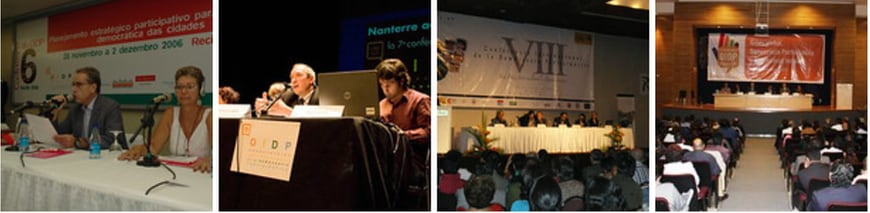
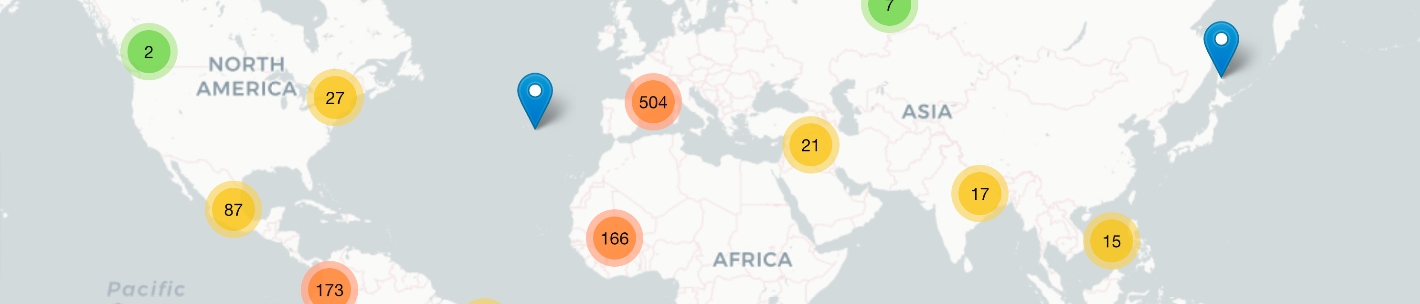
Barcelona 2001 / Quezaltenango 2002 / Lille 2003 / Buenos Aires 2004 / Donostia-San Sebastián 2005 / Recife 2006 / Nanterre 2007 / La Paz 2008 / Reggio Emilia 2009 / Mexico City 2010 / Lleida 2011 / Porto Alegre 2012 / Cascais 2013 / Canoas 2014 / Madrid 2015 / Matola 2016 / Montreal 2017 / Barcelona 2018 / Iztapalapa 2019 / Cocody 2021 / Grenoble 2022 / Rio de Janeiro 2023 / Valongo 2024 / Córdoba (Argentina) 2025
In 2016, the first conference outside the OIDP's founding geographical area in Latin America and Europe took place. It was the 16th OIDP conference in Matola, Mozambique "Good governance and inclusive citizen participation". This event shows the expansion of the OIDP and participatory democracy practices in the African continent, as well as the work of the OIDP regional antenna in Africa. The Matola Conference took place from May 4-6, 2016 with the participation of more than 1,500 people. It was organized in two plenary sessions and six working groups, in addition to the opening and closing ceremonies, the OIDP General Assembly and the technical visits of the Matola participatory experiences.
The next conference took place this time in North America, in the city of Montreal, which focused the theme of the meeting on inclusion in participatory processes.
In 2018 the conference was again organized in the city of Barcelona, introducing the themes of direct democracy and citizen initiative as drivers of democratic renewal in cities.
In 2019 the theme of the right to the city was at the center of the work of the conference, which was organized for the second time in Mexico City, this time in the municipality of Iztapalapa.
In 2020, due to the COVID-19 pandemic, the annual conference could not be held for the first time since our foundation. Together with UCLG, the OIDP started to organize more virtual activities from that moment on. Although the pandemic context remained complex, the second OIDP Africa conference took place in October 2021, this time in the Commune de Cocody in Abidjan, Ivory Coast. From October 20 to 22 was the face-to-face conference and from November 29 to December 2 the virtual sessions of the conference took place.
In 2022, the OIDP conference is taking place in Grenoble, in the framework of the European Green Capital. The theme of this edition is therefore closely linked to the necessary ecological transformation that we must carry out in our societies, also in cities and territories, together and with the active participation of citizens. In recent years, the OIDP has incorporated the ecological dimension, which we believe must go hand in hand with democracy, in order to avoid authoritarian responses to the crises we must face.
Following the Rio de Janeiro Conference in 2023, the OIDP began to incorporate into its agenda the need to promote democratic regulation of artificial intelligence based on a human rights approach. The political declaration of this meeting highlighted the negative impact of the spread of fake news and deep fakes on open and democratic societies. In response, a call was made to promote regulations that ensure that large digital platforms foster balanced public debate and prevent algorithms from amplifying extremist discourse.
This dialogue continued at the 23rd OIDP Conference, held in Valongo in 2024, which highlighted the central role of building participatory communities to strengthen democratic resilience in the face of the threats of populism. The need to develop human rights-centered artificial intelligence and to put civic technologies at the service of public participation was reiterated. In line with the debate initiated in Grenoble, the imbalance in the ecological transition between high-emitting countries—mainly in the global North—and developing countries, which are more vulnerable to its consequences, was also highlighted.
The Conference held in Córdoba (Argentina) in 2025 explored the importance of building community, connecting, integrating, and humanizing decision-making. The role of the local and regional levels in promoting truly inclusive multilateralism was highlighted. In a global context marked by geopolitical tensions, climate challenges, democratic setbacks, and persistent inequalities, the OIDP community reaffirmed participation as a key tool for building sustainable solutions from the local level. As a result of the meeting, the creation of two instrumental bodies to promote more inclusive governance was approved: the Gender and Youth Advisory Committees.
For the elaboration of this report of the OIDP and the municipalist movement in defense of participatory democracy we have had the collaboration of Pere Alcober, Yves Cabannes, Vanessa Marx, Ramon Nicolau, Francesc Osan, Melissa Pomeroy, Eva Salaberria and Eulàlia Tubau, people who have been closely linked to the history of this network of municipalities.




 Join the OIDP